Mini Implants vs. Standard Implants for Dentures: Where Minis Still Make Sense (and Where They Don’t)
Understanding Mini and Standard Implants in Clinical Dentistry.
In restorative implant dentistry, size and stability matter. While mini dental implants were once widely used as a cost-effective and minimally invasive solution for denture stabilization, their long-term performance compared to standard-diameter implants is a frequent topic of debate among clinicians. Understanding when mini implants work – and when they do not – is essential for predictable outcomes.
At the Advanced Dental Implant & TMJ Center, Dr. Pradeep Adatrow evaluates each case using 3D imaging and bone density analysis to determine the safest and most biomechanically sound treatment option.
Mini Dental Implants: Definition and Design.
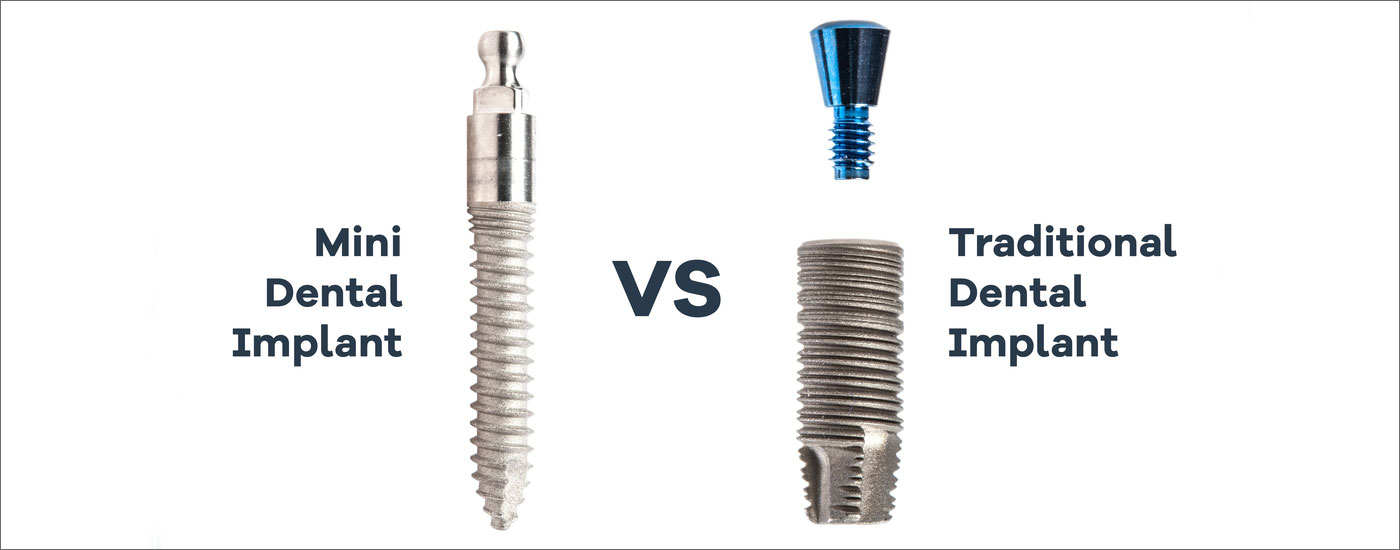
Mini dental implants (MDIs) are small-diameter implants, typically ranging from 1.8 mm to 3.3 mm in width. They are designed as one-piece systems with an integrated abutment, eliminating the need for a separate screw connection.
Their smaller size allows placement in areas with limited bone without the need for grafting, which appeals to patients seeking less invasive, lower-cost solutions.
Clinical Advantages of Mini Implants.
Mini implants can be advantageous in specific situations where anatomical, financial, or medical factors limit treatment options:
- Minimally Invasive Placement – Requires smaller osteotomy and often avoids flap surgery.
- Reduced Chair Time – Many procedures can be completed in a single appointment.
- No Bone Grafting Required – Suitable for narrow ridges or patients unwilling to undergo grafting.
- Immediate Loading Potential – In select overdenture cases with sufficient torque (≥35 Ncm).
- Lower Initial Cost – Provides a budget-conscious stabilization solution for removable prostheses.
Limitations and Risks of Mini Implants.
Despite their simplicity, mini implants have significant biomechanical and long-term limitations when compared to standard-diameter implants.
- Reduced Load Capacity – Due to their smaller surface area, they can’t withstand heavy occlusal or parafunctional forces (e.g., bruxism).
- Higher Fracture Risk – The one-piece design and thin diameter make them more prone to bending or breaking under stress.
- Limited Use in Fixed Restorations – They are best for overdentures, not full-arch fixed prostheses.
- Difficult Maintenance and Replacement – Once fractured, replacement often requires additional surgery.
- Questionable Long-Term Predictability – Studies show higher failure rates over 5–10 years compared to standard implants.
Standard-Diameter Implants: The Clinical Gold Standard.
Standard implants typically range from 3.5 mm to 5.0 mm in diameter and are considered the benchmark for long-term implant success. Their larger diameter provides enhanced primary stability, greater surface area for osseointegration, and superior load distribution.
Dr. Adatrow often recommends standard implants for full-arch, All-on-X, and fixed hybrid restorations, especially in patients with moderate to dense bone. With proper placement torque and prosthetic design, these implants can last decades.
Dr. Adatrow’s Decision Framework: When Minis Still Make Sense.
Mini implants may still be used effectively in transitional or specific palliative scenarios where conventional implants are not feasible due to anatomical or financial constraints:
- Transitional Support – Temporary stabilization for healing phases before standard implant placement.
- Elderly Patients – For whom less invasive procedures are medically safer.
- Severely Resorbed Ridges – Where bone grafting is contraindicated or declined.
- Interim Solutions – Short-term stabilization while planning for full-arch or hybrid restorations.
Dr. Adatrow carefully evaluates bone density, bite forces, and patient expectations before selecting mini implants as a treatment option.
Mini vs. Standard Implants – Clinical Comparison.
| Feature | Mini Implant | Standard Implant |
| Diameter | 1.8–3.3 mm | 3.5–5.0 mm |
| Load Capacity | Limited | High |
| Bone Requirement | Minimal | Moderate |
| Use Case | Overdentures / Temporary | Fixed / Full-Arch |
| Longevity | 5–7 years avg. | 15–25+ years |
| Cost | Lower upfront | Higher initial, lower long-term cost |
Clinical Takeaway.
Mini implants are not a one-size-fits-all solution. While they can serve a valuable role in select cases, standard implants remain the preferred choice for most full-mouth and fixed rehabilitations. The decision should always be evidence-driven – factoring bone quality, functional load, and long-term prognosis.
At the Advanced Dental Implant & TMJ Center, Dr. Adatrow employs a data-backed, patient-specific approach to implant selection to ensure durability, comfort, and esthetic excellence.
FAQs: Mini vs. Standard Dental Implants.
Are mini implants as strong as regular implants?
Can mini implants be used for fixed teeth?
Do mini implants require bone grafting?
Are mini implants cheaper than standard implants?
When do you recommend mini implants?
Explore Related Treatments
Discover how implant-retained dentures improve stability at Snap-On Dentures or learn about conventional prosthetics at Dentures.
Do you have any further questions about Dental Implants?
If you have any further questions about Dental Implants, you can schedule a consultation with Dr. Adatrow. Dr. Adatrow has more than 20 years of experience in placing dental implants, with a success rate of over 97%, and can provide you with the best possible dental treatment. He is a Board-Certified Prosthodontist and Periodontist in Hernando, MS region. Please get in touch with our office for your consultation now!